| МОК: | 1 шт. |
| цена: | USD9.99-99.99 |
| Стандартная упаковка: | Вакуумные пакеты+коробки |
| Срок доставки: | 8-9 рабочих дней |
| Способ оплаты: | Т/Т |
| Пропускная способность: | 5000ПК в месяц |
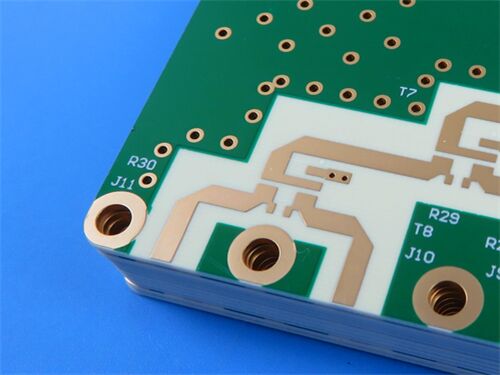
This PCB is a 6-layer copper structure, and its material composition mainly includes RO4003C core, RO4450F prepreg and copper foil.
PCB Details
| Specification Item | Details |
| Layer Structure | Top layer (0.203mm RO4003C) + 2PCS RO4450F Prepreg + Middle layer (0.203mm RO4003C) + 2PCS RO4450F Prepreg + Bottom layer (0.203mm RO4003C) |
| Copper Thickness | Outer layer (L1, L6) - 1oz finished copper (0.035mm); Inner layer (L2-L5) - 0.5oz finished copper (0.018mm) |
| Pressed Thickness | 1.155mm |
| Surface Treatment | Top and bottom layers with green solder mask and white silkscreen; Immersion gold |
| Dimension | 92.5mm × 77.3mm (1PCS) |
| Special Process | Back drilling (L1-L3, L1-L5) |
PCB Stack-up
| Layer No. | Description | Thickness |
| 1 | Copper Layer — L1 (Outer Top, 1oz finished copper) | 0.035 mm |
| 2 | Core RO4003C | 0.203 mm |
| 3 | Copper Layer — L2 (Inner Layer, 0.5oz finished copper) | 0.018 mm |
| 4 | Prepreg RO4450F | 0.101 mm |
| 5 | Prepreg RO4450F | 0.101 mm |
| 6 | Copper Layer — L3 (Inner Layer, 0.5oz finished copper) | 0.018 mm |
| 7 | Core RO4003C | 0.203 mm |
| 8 | Copper Layer — L4 (Inner Layer, 0.5oz finished copper) | 0.018 mm |
| 9 | Prepreg RO4450F | 0.101 mm |
| 10 | Prepreg RO4450F | 0.101 mm |
| 11 | Copper Layer — L5 (Inner Layer, 0.5oz finished copper) | 0.018 mm |
| 12 | Core RO4003C | 0.203 mm |
| 13 | Copper Layer — L6 (Outer Bottom, 1oz finished copper) | 0.035 mm |
| Total Pressed Thickness | 1.155 mm | |
![]()
What is Back Drill?
Back drill (Back Drilling) is a special drilling process used in the manufacturing of high-speed and high-frequency PCBs, whose core purpose is to remove the non-conductive excess copper pillar part (called "stub") in the via hole, so as to significantly improve the integrity of signal transmission.
In multi-layer PCBs, signal lines connecting different layers usually use vias, which typically penetrate the entire thickness of the PCB. When a signal is transmitted from one layer (such as Layer 1) to the target layer (such as Layer 3 or Layer 5) through a via, the part of the via below the target layer (extending to the lower layers) has no electrical connection function, and this excess copper pillar is the "stub". At high speeds or high frequencies, the stub is like a short antenna, which will cause serious signal reflection, leading to signal distortion, timing offset, eye diagram closure, and even system error codes or failure.
The back drilling process solves this problem through secondary drilling: after the conventional PCB manufacturing process is completed, a drill with a diameter slightly larger than the original via hole is used to drill from the back or side of the PCB, and the drilling depth is precisely controlled to just drill through the part below the target layer, so as to physically remove the stub. After removal, the remaining hole wall is a non-conductive substrate that no longer participates in signal transmission, which can greatly reduce signal reflection and loss, improve signal transmission rate, reduce jitter, and optimize signal quality. Compared with other schemes such as HDI blind/buried vias, back drilling has higher cost performance for scenarios that require high-speed vias but not extremely high layers.
In this PCB case, back drilling is applied to the ranges of L1-L3 and L1-L5, which can effectively ensure the signal integrity of high-speed transmission in the PCB.
![]()
Introduction to RO4003C
RO4003C is a proprietary glass cloth reinforced, ceramic-filled hydrocarbon composite material developed by Rogers Corporation, which combines the excellent electrical performance of PTFE/glass cloth and the processability of epoxy resin/glass cloth. The material has two different configurations using 1080 and 1674 glass cloths, and all configurations have the same electrical performance specifications. It has strict process control, stable and consistent dielectric constant (Dk) and low loss characteristics, and its unique mechanical properties make it the same as the standard epoxy resin/glass processing process, while the cost is much lower than that of traditional microwave laminates. Unlike PTFE microwave materials, this material does not require special via processing or operation procedures.
Key Parameters of RO4003C (Data Sheet Core Content)
| Parameter | Typical Value | Remarks/Test Method |
| Dielectric Constant (Dk) @10GHz | 3.38 ± 0.05 | Process typical value; Design typical value is 3.55 |
| Loss Factor (Df) @10GHz | 0.0027 | Typical value, with excellent low-loss performance |
| Z-axis Coefficient of Thermal Expansion (CTE) | 46 ppm/°C | Typical value, -55°C to 288°C |
| Volume Resistivity | 1.7×10¹⁰ MΩ•cm | Typical value, good insulation performance |
| Water Absorption (D48/50%) | 0.04% | Typical value, excellent moisture resistance |
| Thermal Conductivity @50°C | 0.71 W/m•°K | ASTM D5470, good heat dissipation performance |
| Peel Strength (1oz ED Foil) | 6.0 lb/inch (1.05 N/mm) | Typical value, strong bonding force with copper foil |
| Flame Retardant Grade | Non FR | Does not meet UL 94 V-0 standard |
| Lead-free Process Compatibility | Yes | Suitable for lead-free assembly processes |
Application Fields of RO4003C
Benefiting from its excellent electrical performance, processability and cost-effectiveness, RO4003C is widely used in microwave, high-frequency and high-speed electronic equipment fields, mainly including:
Communication Infrastructure: Cellular base station antennas, radio backhaul equipment, telecommunication-grade Wi-Fi/authorized auxiliary access systems, IP infrastructure, and point-to-point microwave communication equipment.
Automotive Intelligence: Automotive radar systems and sensors, supporting the development of autonomous driving and vehicle safety technologies.
High-frequency and High-speed Equipment: Phased array radar systems, power amplifiers, high-speed servers (CPU/GPU/memory interconnection), high-speed network communication equipment (routers, switches, optical modules).
Internet of Things (IoT): RFID antennas, improving identification accuracy and signal coverage.
Other Fields: Test and measurement equipment, aerospace and defense electronic systems, and other equipment that needs to handle Gbps-level high-speed digital signals or radio frequency microwave signals.
![]()
| МОК: | 1 шт. |
| цена: | USD9.99-99.99 |
| Стандартная упаковка: | Вакуумные пакеты+коробки |
| Срок доставки: | 8-9 рабочих дней |
| Способ оплаты: | Т/Т |
| Пропускная способность: | 5000ПК в месяц |
This PCB is a 6-layer copper structure, and its material composition mainly includes RO4003C core, RO4450F prepreg and copper foil.
PCB Details
| Specification Item | Details |
| Layer Structure | Top layer (0.203mm RO4003C) + 2PCS RO4450F Prepreg + Middle layer (0.203mm RO4003C) + 2PCS RO4450F Prepreg + Bottom layer (0.203mm RO4003C) |
| Copper Thickness | Outer layer (L1, L6) - 1oz finished copper (0.035mm); Inner layer (L2-L5) - 0.5oz finished copper (0.018mm) |
| Pressed Thickness | 1.155mm |
| Surface Treatment | Top and bottom layers with green solder mask and white silkscreen; Immersion gold |
| Dimension | 92.5mm × 77.3mm (1PCS) |
| Special Process | Back drilling (L1-L3, L1-L5) |
PCB Stack-up
| Layer No. | Description | Thickness |
| 1 | Copper Layer — L1 (Outer Top, 1oz finished copper) | 0.035 mm |
| 2 | Core RO4003C | 0.203 mm |
| 3 | Copper Layer — L2 (Inner Layer, 0.5oz finished copper) | 0.018 mm |
| 4 | Prepreg RO4450F | 0.101 mm |
| 5 | Prepreg RO4450F | 0.101 mm |
| 6 | Copper Layer — L3 (Inner Layer, 0.5oz finished copper) | 0.018 mm |
| 7 | Core RO4003C | 0.203 mm |
| 8 | Copper Layer — L4 (Inner Layer, 0.5oz finished copper) | 0.018 mm |
| 9 | Prepreg RO4450F | 0.101 mm |
| 10 | Prepreg RO4450F | 0.101 mm |
| 11 | Copper Layer — L5 (Inner Layer, 0.5oz finished copper) | 0.018 mm |
| 12 | Core RO4003C | 0.203 mm |
| 13 | Copper Layer — L6 (Outer Bottom, 1oz finished copper) | 0.035 mm |
| Total Pressed Thickness | 1.155 mm | |
![]()
What is Back Drill?
Back drill (Back Drilling) is a special drilling process used in the manufacturing of high-speed and high-frequency PCBs, whose core purpose is to remove the non-conductive excess copper pillar part (called "stub") in the via hole, so as to significantly improve the integrity of signal transmission.
In multi-layer PCBs, signal lines connecting different layers usually use vias, which typically penetrate the entire thickness of the PCB. When a signal is transmitted from one layer (such as Layer 1) to the target layer (such as Layer 3 or Layer 5) through a via, the part of the via below the target layer (extending to the lower layers) has no electrical connection function, and this excess copper pillar is the "stub". At high speeds or high frequencies, the stub is like a short antenna, which will cause serious signal reflection, leading to signal distortion, timing offset, eye diagram closure, and even system error codes or failure.
The back drilling process solves this problem through secondary drilling: after the conventional PCB manufacturing process is completed, a drill with a diameter slightly larger than the original via hole is used to drill from the back or side of the PCB, and the drilling depth is precisely controlled to just drill through the part below the target layer, so as to physically remove the stub. After removal, the remaining hole wall is a non-conductive substrate that no longer participates in signal transmission, which can greatly reduce signal reflection and loss, improve signal transmission rate, reduce jitter, and optimize signal quality. Compared with other schemes such as HDI blind/buried vias, back drilling has higher cost performance for scenarios that require high-speed vias but not extremely high layers.
In this PCB case, back drilling is applied to the ranges of L1-L3 and L1-L5, which can effectively ensure the signal integrity of high-speed transmission in the PCB.
![]()
Introduction to RO4003C
RO4003C is a proprietary glass cloth reinforced, ceramic-filled hydrocarbon composite material developed by Rogers Corporation, which combines the excellent electrical performance of PTFE/glass cloth and the processability of epoxy resin/glass cloth. The material has two different configurations using 1080 and 1674 glass cloths, and all configurations have the same electrical performance specifications. It has strict process control, stable and consistent dielectric constant (Dk) and low loss characteristics, and its unique mechanical properties make it the same as the standard epoxy resin/glass processing process, while the cost is much lower than that of traditional microwave laminates. Unlike PTFE microwave materials, this material does not require special via processing or operation procedures.
Key Parameters of RO4003C (Data Sheet Core Content)
| Parameter | Typical Value | Remarks/Test Method |
| Dielectric Constant (Dk) @10GHz | 3.38 ± 0.05 | Process typical value; Design typical value is 3.55 |
| Loss Factor (Df) @10GHz | 0.0027 | Typical value, with excellent low-loss performance |
| Z-axis Coefficient of Thermal Expansion (CTE) | 46 ppm/°C | Typical value, -55°C to 288°C |
| Volume Resistivity | 1.7×10¹⁰ MΩ•cm | Typical value, good insulation performance |
| Water Absorption (D48/50%) | 0.04% | Typical value, excellent moisture resistance |
| Thermal Conductivity @50°C | 0.71 W/m•°K | ASTM D5470, good heat dissipation performance |
| Peel Strength (1oz ED Foil) | 6.0 lb/inch (1.05 N/mm) | Typical value, strong bonding force with copper foil |
| Flame Retardant Grade | Non FR | Does not meet UL 94 V-0 standard |
| Lead-free Process Compatibility | Yes | Suitable for lead-free assembly processes |
Application Fields of RO4003C
Benefiting from its excellent electrical performance, processability and cost-effectiveness, RO4003C is widely used in microwave, high-frequency and high-speed electronic equipment fields, mainly including:
Communication Infrastructure: Cellular base station antennas, radio backhaul equipment, telecommunication-grade Wi-Fi/authorized auxiliary access systems, IP infrastructure, and point-to-point microwave communication equipment.
Automotive Intelligence: Automotive radar systems and sensors, supporting the development of autonomous driving and vehicle safety technologies.
High-frequency and High-speed Equipment: Phased array radar systems, power amplifiers, high-speed servers (CPU/GPU/memory interconnection), high-speed network communication equipment (routers, switches, optical modules).
Internet of Things (IoT): RFID antennas, improving identification accuracy and signal coverage.
Other Fields: Test and measurement equipment, aerospace and defense electronic systems, and other equipment that needs to handle Gbps-level high-speed digital signals or radio frequency microwave signals.
![]()